We don't drive up the Pacific Highway when we go up to Lismore, instead we take the inland route up Red Hill and through the Orara Valley to Nana Glen, then on to Glenreagh and Grafton before picking up the 91 Sumerland Way through Casino to Lismore. It's a beautiful drive: mainly lovely, fairly straight roads through forest, gradually climbing until you come down off the tops near Casino and get a wonderful view of the mountains before winding your way through munching cattle and sugar cane fields and hit the beginnings of the dead volcano country around Lismore. MUCH nicer than dicing with death and the B-doubles along the Pacific Highway. When the roadhouse at Whiporie is open, 50km north of Grafton, I stop off for a very decent coffee but this time we were on a mission to get there for the Southern Cross Acquisitive Artists' Book Awards at 4pm so we forewent our coffee and hurried along.

Victoria Cooper and Doug Spowart: Australian Banquet
Sadly, dear members of Edition One, we did NOT make the cut at the Southern Cross University Artists' Book Awards, for reasons I will tell you about shortly!

Nicci Haynes: Threads
This is the first year of the awards becoming a biennial event rather than an annual event: not only was it too much work for the University's Next Art Gallery staff on only 10 hours a week, but every other year it clashed with the Libris Awards at Mackay, so I think changing it to alternate with the Libris Awards was a sensible decision. However, few people were aware of the change, and fewer still realised that instead of the SCU event being held in August it was moving to February, and I wonder if that affected the number and quality of entries? Another change was the move back into the University's own gallery in central Lismore, rather than holding it at Julie Barratt's eponymous gallery in Alstonville as they did in the other two Awards I entered in 2008 and 2009. There are positives and negatives in this decision too: I was talking to Shelagh Morgan, the Next Art Gallery’s director, and she commented that the Awards are very important for the Visual Arts Department at Southern Cross University, and that they needed to be brought back ‘in house’ before they became permanently associated with Barratt Galleries in people’s minds, and I can see that.

Angela Cullip: Domestic Landscape
There is no doubt that Barratt Galleries is a much more salubrious venue! It’s a lovely old house in Alstonville, with lots of space and a nice atmosphere – and it’s a professional gallery that runs many events in a very professional way. Next Art Gallery is a university art gallery, and my experience of these – which seemed to me to be borne out in Lismore – is they tend to me slightly shabby places, small by necessity because the university concerned won’t spend much money on them, and that they retrain traces of their primary function, which is to display undergraduate work and Finals presentations rather than exhibitions of a more professional calibre. You could see this in the pinched proportions, the lack of ‘back room’ facilities such as storage or a proper kitchen, the damaged plinths, hand-written number stickers, and the poverty-stricken catering.

Deborah McArdle: Knowledge II
I’m not actually complaining. I think what Shelagh achieves on what is probably a shoe-string budget is little short of miraculous, but there is an inconsistency in university administration almost everywhere: on the one hand the visual arts are “important” in the sense that they contribute in some nebulous way to the conversation educationalists and industrialists are having about how best to equip young people with the flexibility, imagination and creativity apparently lacking in the current generation of world leaders and desperately needed by the next… And yet how much easier it is to justify the purchase of ever-improving IT equipment, science lab equipment or library shelving than it is to justify spending money on the university’s poor little gallery which is only frequented by young people with strange hair, piercings and tattoos… It would be wonderful if a visionary Dean of the Visual Arts Faculty at SCU could somehow persuade university authorities either to invest in the gallery (expansion, new plinths, more hours of admin time for the gallery staff, a decent computer system perhaps, money for training and labels and a budget for catering for exhibition openings … just a thought), OR to move it into the University main buildings: to make it a flagship and focus of the main atrium, something to shout about.
Interestingly I saw this happen with amazing success at the University of the West of England in Bristol, when I revisited for the last Impact printmaking conference in 2009: a rebuild of the Bower Ashton campus (where Visual Arts is based, among other faculties) saw exhibition and display areas central to the overall design, and valued as a way of showcasing the university. Hoorah. But then, Richard Anderton (“Tricky Dicky” to the rest of us) has always been a sharp political animal, and I guess he had a big part to play in pushing that agenda when the building program was conceived.
I should probably stop ranting about university funding battles and interesting undergraduates (hail Jessie! Well over 6 feet tall if he’s an inch, hairy, beardy and yesterday wearing a very nice dress with his big boots and with a cigarette lighter shoved through the hole in his ear. He’s a very interesting man, Jessie). I should probably tell you about the Awards!
Personally I felt as soon as I walked in that there was something different about this year, and it wasn’t just the change in venue, the change in timing, the move towards pre-selected entry or the expansion to include international entrants. Or perhaps it was all of those things combined that made for a much smaller show, and as I went round I kept thinking that there were lots of names I would have expected to see represented, who weren’t there. Monica Oppen, Tim Mosely, Gail Stiffe, Bea Maddock, Diane Longley, and others… where were you? So yes, it was a smaller show: just 46 works this year by 36 artists, and I’m not sure who was Australian and who was from overseas because it didn’t tell you anywhere.

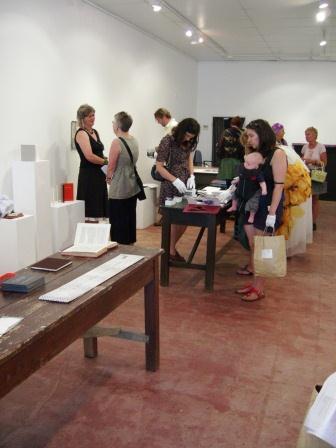
Of course the first thing I did was to find a) where BookArtObject Edition One was positioned, and b) look for individual pieces by BookArtObject members which this year included me, Ronnie and Fiona. Luckily dearest husband and I arrived fairly early which meant I was able to remove the packaging material from my individual piece (!), and also take the BAO books out of their wrappings and prop them up more attractively on their plinth so that people wanted to look at them (!!). It was rather lovely to overhear several people talking about the BAO pieces. Everyone got an A4 list of entries with their white gloves at the door, but there wasn’t room on the list for any explanation: that was left to the printed catalogue which was $10 at the desk, and I didn’t see many people buying it, so I spent some of my time lurking next to our plinth and pouncing on interested visitors, explaining about the project and its genesis. And people were interested. In fact I had no fewer than 4 personal enquiries about joining the group for Edition 3 (*gulp*), and LOTS of positive comments. Dearest husband picked up on this too, and said that his observation was that many people were talking about our edition AND about the BAO blog. In fact I was quite taken aback to be harried by BAO blog enthusiasts! This goes with a sudden surge of interest in BAO through the Artists Books 3.0 Ning community recently: I’ve fielded another half a dozen enquiries that have come out of nowhere through that path, and basically I’ve told everyone that there will be another ‘call for entries’ later this year when (* more gulping *) we’ve finished Edition Two and are thinking about Edition Three. Blimey, what have we started?!

Rhonda Ayliffe: Orbis Floris

Fiona Dempster: My Journey is My Way Home
I was also chuffed to bits to find that Jan Davis, formerly Associate Professor at the school of Visual Arts at Southern Cross and my PhD supervisor, was interested: she hadn’t made the connection between me and the group which is good because she was one of the selectors and can’t therefore be accused of favouritism! It was lovely to meet up with Jan, and with Julie Barratt, Louise Irving and a host of other people I don’t see very often, and also to meet Fiona and Barry Dempster at long last! Fiona is every bit as interesting and beautiful in person as she is on her blog and the BAO blog and it was a pleasure to meet her. She and Barry had driven down from Brisbane, having only that day flown up from Melbourne and they were understandably exhausted so sadly we weren’t able to share a post-opening pizza, which was probably just as well as we had to drive back to Coffs Harbour. I hope one day I’ll make it up to the hive of creative activity that is Maleny and meet them again!
Anyway, I still haven’t told you about the speechifying that officially opened the exhibition, which came courtesy of Professor Ross Woodrow of Griffith University, Queensland. He was the one with the heavy responsibility of selecting work to be acquired for the SCU book arts collection, and honestly, there was a collective gasp of astonishment from almost everyone present as soon as he started speaking.
[Just so we're clear, anything with double quote marks around it came out of Professor Woodrow's mouth]
His message was the “the more a piece approaches sculpture the less appealing it is as a book”. Now he hedged this around with a lot of apologising that this was his personal view and he said himself that he thought it was important to be “up front” about his “taste”, but I would say that over 80% of the people in the room looked aghast as soon as he started speaking. It made for a very interesting and entertaining discussion, and indeed we discussed it for about an hour and a half on the way home in the car. Clearly Professor Woodrow’s personal preferences are going to shape his selections, but it was this personal bias PLUS his judgement on the worth of the Southern Cross University book arts collection that left me slightly speechless. He told us how he’d gone to view the collection the day before with Jan Davis and had formed the view that although the collection is embryonic (I’d be surprised if there are more than 30 pieces, although I haven’t counted), it has the potential to be ‘great’, and by great he seems to mean ‘valuable’ in a financial sense only, and ‘representative’, in the sense of having mainly works by established artists. With that stupendous set of value judgements in mind he quite openly and deliberately chose “big ticket items” at “the top end” of his scale of values, by mainly established artists. This meant he chose precisely three works and managed to overspend his $4,000 budget because Lyn Ashby’s The Ten Thousand Things was $1,500, Peter E Charuk’s Glacies Lux was $1,200 and Peter Lyssiotis and Ann-Maree Hunter’s A Modern Forest was $1,500. Not a look-in for anyone else.
Then, to my amazement, he proceeded to lambast (gently) other artists for overpricing their work! It seems you can only put a steep price on your efforts and labour if you are already an established artist…
So what IS the purpose of the university’s book arts collection? Interestingly, if you look at the university’s website it says:
“SCU is one of a small number of Australian public collections to focus on artists’ books as specialised collection area. The collection is linked to the academic program at SCU and the existing collection is utilised regularly by academics in the pursuit of their teaching and learning objectives. SCU is recognised nationally as having made a significant contribution to the development and awareness of artists’ books as an art form in their own right.”
Nothing there about the collection being a financial investment. I mean, do institutions really start acquiring work because they want it to be worth lots of money? Doing so creates its own problems: attribution, authenticity, valuation reports, insurance, display, dedicated storage… My view is that Southern Cross started the collection for exactly the reasons it stated: they had an internal interest within the school of Visual Arts in the development of artists’ books, they’d already formed links with other institutions such as UWE in the UK who were pushing artists’ books, they were teaching undergraduates about artists’ books, and if there is likely to be any financial pay-back in collecting artists’ books it is more likely to be because they inadvertently collect early work by up-and-coming artists whose portfolio increases in value over time, which in itself invalidates Ross Woodrow’s collection policy!
So, a few more quotes from Professor Woodrow:
“I am wary of books that test the definition of a book”It was funny looking around the room at the other artists (other than myself, that is) whose work ‘tests the definition of a book’, and watching our collective faces fall as we realised our work was ‘less appealing’. Luckily the interest generated by BookArtObject and our blog MORE than makes up for the lack of acquisition. The only down-side is that I’ll have to make another bloody trip up to Lismore to collect everything once the exhibition ends on March 21st.
“It’s a conservative selection”
“A book is an object that contains within its perimeter a consistent, coherent idea… something you would expect to find in a book”

By the way, Shelagh kindly gave me a pile of catalogues for the show which will be wending their merry way to you in due course, once I’ve got enough money for the postage. It could take a while (sorry folks), but you’ll get it eventually.


